

Imagine a perfect crescent of soft white sand lapped by calm turquoise waters, with a lone, bizarrely shaped boulder rising from the shallows. This is Playa Balandra in Baja California Sur, and at its heart stands El Hongo – the Mushroom Rock. Visitors line up under the hot sun to snap its photo, crowning it one of the most iconic natural symbols of the peninsula. Its strange form – a flared top balanced on a slender base – almost seems to defy gravity and logic. How did this rock get here? As we’ll discover, the story of El Hongo is part geological mystery, part time capsule of thousands of years, and part lesson in how humans must work to preserve nature’s wonders.
Planning to visit? Start with this complete Playa Balandra guide to understand how access, timing, and entry actually work.
| Feature | Details |
| Name | El Hongo (Mushroom Rock) |
| Location | Playa Balandra, Baja California Sur, México |
| Formation Type | Sedimentary rock (sandstone & limestone) |
| Age | Millions of years (geological formation) |
| Height | Several meters above sea level |
| Famous For | Mushroom-like shape & beach setting |
| Protection Status | Natural Protected Area |
| Best Viewing Time | Low tide, sunrise/sunset |
Before diving deeper, here’s a quick snapshot of what makes El Hongo one of the most fascinating natural landmarks in Mexico. This overview helps you understand its significance at a glance, whether you’re a traveler, student, or nature enthusiast.
What Is the Balandra Mushroom Rock?
Locally known as “El Hongo de Balandra” (Spanish for the mushroom of Balandra), this rock is a natural sandstone formation shaped like a giant toadstool. It rises several meters above the shallow bay, with a narrow stem and a broad, flat cap. The rock is embedded in the soft sand and crystal waters, making it easily accessible by foot when the tide is low. Situated roughly 25 km north of La Paz on State Highway 11, the bay’s calm lagoon and sandbars surround the Mushroom Rock, which has become the symbol of La Paz. In tourism brochures and social media alike, El Hongo is the face of Playa Balandra – the must-see landmark that travelers associate with this famously beautiful beach.
The Geological Formation: How Nature Sculpted It
Wind and Water Erosion Over Time
El Hongo’s unusual shape is pure nature’s handiwork. Over thousands (even millions) of years, relentless waves, tides, rain, and wind have carved this boulder. In geological terms, it’s a prime example of differential erosion – when different parts of the same rock wear away at different rates. Here’s how it happens: the constant pounding of water and wind gradually chisels away the rock’s base faster than its upper layers. Currents and waves lap its sides, little by little eroding the sandstones and limestones at the bottom. Rainwater and wind abrasion similarly attack any softer strata. Over many millennia, this steady erosion undercut the base much more than the cap, sculpting the familiar “mushroom” profile.
Role of Sedimentary Rock
The Mushroom Rock is composed of layered sedimentary stone – primarily sandstone and limestone. Sedimentary rocks are born of ancient seabeds or dunes, cemented into layers over eons. Crucially, these materials vary in hardness. The lower layers around the base are often softer or more fractured, so they wear down faster under pounding waves. The upper part of the rock, by contrast, is made of denser, tougher material that resists erosion. As geologists note, this uneven hardness is key: the harder caprock stays largely intact while the softer stem erodes, giving El Hongo its lopsided profile.
Thousands of Years in the Making
This incredible sculpture is not the result of a single storm or even a human hand; it is the outcome of vast spans of time. Scientists estimate that Balandra’s Mushroom Rock took millions of years to form. Each tiny grain of sand chipped away over epochs, each drop of rain steadily deepening the undercut. In geological terms, El Hongo is a youthful relic – remarkably fresh given its complexity – but still the product of natural forces acting slowly over countless generations. In fact, the rock’s very survival is a reminder of how gradually change happens: what we see as “time” is merely an instant in the planet’s history. Many other parts of Earth’s crust show similar erosion wonders, but Balandra’s Mushroom Rock is unique for its setting (framed by the sea and beach) and accessibility to visitors.
Formation Process Simplified
To simplify the science, the Mushroom Rock didn’t appear overnight. It evolved through a slow, multi-stage natural process where time, pressure, and erosion worked together like a sculptor shaping stone.
Step-by-Step Formation
| Stage | Process | Result |
| 1 | Sediment deposition | Layers of sandstone & limestone form |
| 2 | Hardening over time | Rock becomes compact |
| 3 | Wave erosion | Base begins to wear down |
| 4 | Wind abrasion | Surface gets sculpted |
| 5 | Differential erosion | The base erodes faster than the top |
| 6 | Final shape | Mushroom-like structure forms |
Why It Looks So Fragile (But Stands Strong)
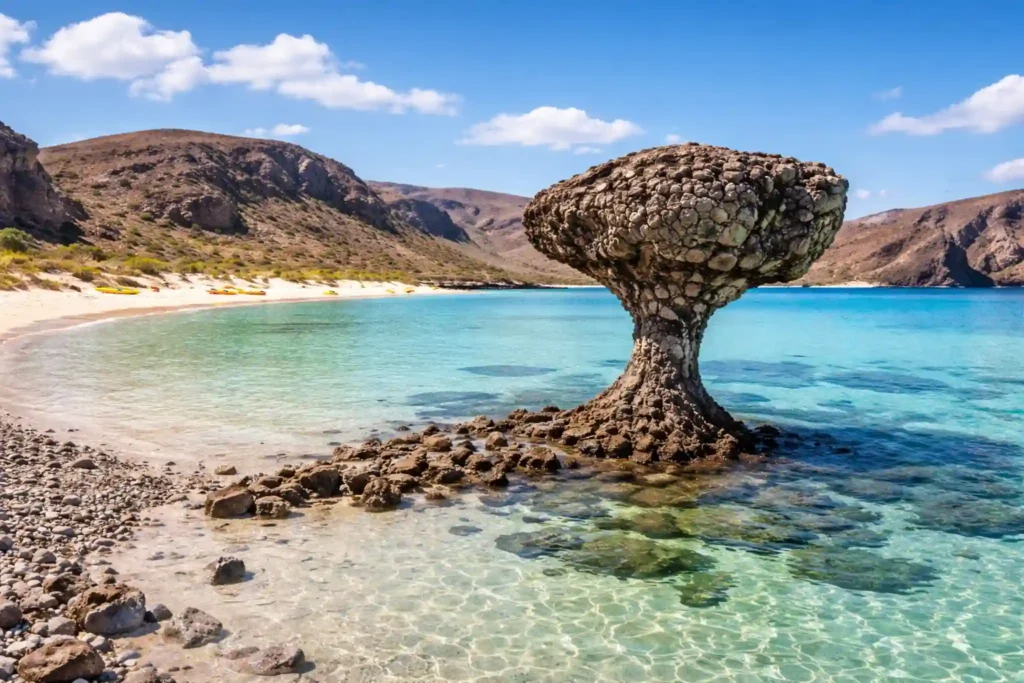
At first glance, El Hongo looks fragile, with a thin neck supporting a large cap. However, it remains stable due to strong internal rock layers and balanced weight distribution. The tougher upper layers resist erosion, while the base, though narrow, still supports the structure. Despite this stability, the rock is gradually thinning and could become unstable over time, making conservation efforts essential.
Risk Factors: What Could Destroy It?
Despite its resilience, El Hongo is not indestructible. Understanding these risks highlights why strict conservation rules are not optional, but essential for its survival.
Threat Analysis
| Threat | Impact Level | Description |
| Human climbing | High | Can cause structural collapse |
| Coastal erosion | Medium | Gradually weakens the base |
| Climate change | Medium | Rising sea levels increase erosion |
| Tourism pressure | Low–Medium | Overcrowding stresses the environment |
| Natural disasters | Low | Storms could accelerate damage |
Cultural and Symbolic Importance
Icon of Balandra Beach. In the local mind and tourist eye, El Hongo is the symbol of Playa Balandra. You’ll see its silhouette on postcards, posters, and Instagram feeds – it’s the visual identity of the beach and, by extension, the La Paz region[2][7]. For years, travel promotions of Baja California Sur have featured the mushroom rock as their centerpiece. Visitors frequently remark that the moment they arrive, their gaze is immediately drawn to this solitary formation. In a sense, the rock personifies the relaxed paradise of Balandra – tranquil waters, powdery sand, and a touch of mystery. As one travel writer noted, thousands queue up to photograph “this natural wonder” because it defines Baja’s beauty.
Social Media Fame. In the age of selfies and Instagram, El Hongo has become a “must-shoot” destination. Tourists line up patiently in the shallow waters with their cameras or phones, waiting for the perfect shot in front of the rock. In fact, it’s “not unusual to see long lines” of people eager to frame themselves beside this giant mushroom[8]. Every year, viral travel photos from Balandra go around the world – often showing the rock’s reflection in the tide pool or a silhouette at sunset. This social-media virality has only amplified its fame, making the rock a global icon for Mexican beach beauty.
Local Pride. For residents of La Paz and Baja California Sur, El Hongo is more than a tourist gimmick – it’s a natural treasure and point of pride. Local guides, park staff, and community leaders tout the rock as a crown jewel of their natural heritage. Its status as a protected landmark means that many local conservation efforts emphasize “the mushroom rock” as an example of what needs defending. When it briefly fell in 1989, the La Paz community reacted with alarm and rallied to have it restored. In daily life too, the rock’s image appears on shop signs, local websites, and even art – a testament to how deeply it’s woven into the region’s identity. In short, El Hongo stands as a symbol of the unique environment around La Paz and a reminder of why locals cherish Balandra Bay.
The Collapse and Restoration Story
The Incident (Human Impact)
It may be hard to believe, but El Hongo was once toppled – not by nature, but by people. In the late 1980s, a group of tourists climbed up the Mushroom Rock for photos. This seemingly harmless act proved disastrous: their weight fractured the narrow base, causing the entire top section to collapse[9]. The incident (reported around 1989) sent shockwaves through the local and national community. It was a wake-up call that even a natural wonder like this is not invincible when human whims intrude. The collapse underscored how fragile the formation really is once stressed beyond its carrying capacity. (Authorities had already warned visitors: climbing on the rock was banned, but evidently the rule wasn’t followed that day.)
Partial Collapse
When the rock gave way under that weight, the result was dramatic – the top cap flopped over and half-submerged in the sand and water. Thankfully, the damage was only partial (the cap remained largely in one piece), but the silhouette we see today was broken. The beach community watched anxiously as engineers surveyed the fallen stone in 1990. Photographs from the time show the Mushroom Rock lying on its side, truly appearing broken beyond repair. For everyone, it was a painful sight: one of Balandra’s beloved icons, lying prostrate on the shore[9].
Restoration Efforts
Rather than abandon the landmark, the authorities undertook a remarkable restoration mission. By 1993, a team of engineers and workers with cranes and heavy machinery had reassembled the rock. They carefully lifted the capstone back onto its stem and rebalanced the pieces, essentially “welding” nature’s sculpture back into place[9]. This operation was no easy feat – El Hongo weighs many tons, and handling it without further damage required precision. In the end, the rock was successfully returned to its pedestal, and over time, park rangers and the sea did the rest to refill any gaps. Remarkably, today’s Mushroom Rock stands almost identically as it did before the collapse – a testament to both engineering efforts and nature’s resilience.
Lessons Learned
The fall and rebirth of El Hongo taught everyone a lesson in conservation. First, it highlighted the impact of human behavior on fragile natural sites. A fun photo op almost cost Baja California Sur one of its top attractions. Second, the reconstruction showed that local authorities take heritage seriously; they were willing to spend resources to undo the damage. But perhaps the biggest takeaway was educational: since the 1990s, park managers have redoubled efforts to protect El Hongo. Today, that means clear rules (no climbing), guides on site, and even legal penalties for violating them. The community continues to treat the rock’s story as an example – reminding visitors that enjoying nature comes with the responsibility to preserve it.
Rules to Protect the Mushroom Rock Today
Balandra is now an officially protected area (Área Natural Protegida)[10], and El Hongo benefits from strict conservation rules. Key regulations include:
- No touching or climbing: Visitors are strictly prohibited from climbing or touching El Hongo or the dune.
- Stay on marked paths: Only use designated trails; avoid dunes and restricted areas.
- Take your trash with you: No littering, pack out everything you bring.
- Limited entry with reservation: Daily visitors are capped; booking and a small fee are required.
- Strict legal penalties: Damaging the area can lead to heavy fines or even imprisonment.
| Do’s ✅ | Don’ts ❌ |
| Take photos from a distance. | Climb the rock |
| Follow marked paths | Walk on the dunes |
| Visit during low tide. | Ignore tide conditions |
| Carry out trash | Leave waste behind |
| Respect park rules | Touch or damage the rock. |
These rules reflect a broader shift: Balandra Bay is conserved first and enjoyed second. Signs at the entrance remind visitors that this is a fragile gem. By following the guidelines – not climbing, keeping the area clean, and abiding by ranger instructions – tourists help ensure that future generations can marvel at the Mushroom Rock just as we do today.
Best Time to Visit and See the Rock
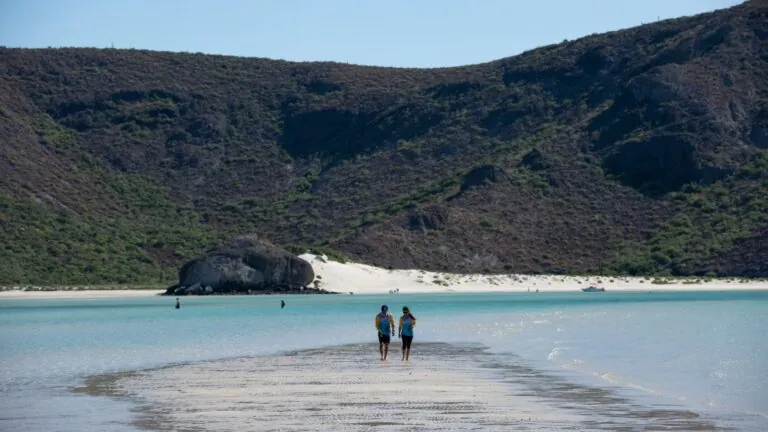
Timing your visit can make a big difference in how the Mushroom Rock looks (and how many people you’ll share it with). Consider these tips:
- Season: The park recommends visiting between October and March. These months have milder temperatures and generally clear skies. (Summer afternoons can be scorchingly hot.) Off-season visits also tend to see fewer crowds.
- Tide: Low tide is by far the best time to appreciate El Hongo. When the tide goes out, the sandbars and shallow bays emerge, allowing you to walk right up to the rock or capture its reflection in the shallow pools. During high tide, much of the foreground sand disappears under water, making access trickier and the setting less dramatic. In fact, experienced travelers report that the landscape is most magical at low tide, when the rock appears to rise from a golden reef.
- Time of Day: For photos and comfort, early morning or late afternoon are ideal. The light is gentler, the colors warmer, and the crowds smaller. Many visitors even line up before sunrise to catch the pink dawn glow on the water and rock. In contrast, midday sun can wash out the vibrant turquoise and create strong shadows. We also recommend arriving early before each entry slot; park staff advises showing up at least an hour before your scheduled time to avoid long lines.
- Weekdays vs. Weekends: As a rule of thumb, weekdays are quieter than weekends or holidays. If your schedule allows, plan for a weekday visit. The park enforces a strict visitor cap (450 persons per time slot), so avoid peak demand by choosing an off-peak day.
By syncing your trip with these conditions, you’ll get the most out of Playa Balandra. Weaving together the right tide, light, and fewer people will turn a simple beach stroll into a true encounter with this natural monument.
Photography Guide: Capturing the Icon
El Hongo practically beckons photographers, but a few tricks can elevate your snapshot into a keeper.
Best Angles
- Front and Center: One classic shot is facing the rock straight on at a distance. From the shallow water or sand in front, you can frame the entire mushroom silhouette against sea and sky. This showcases its distinctive cap-and-stem shape.
- Reflection Shot: When the tide is low, the wet sand and calm water form a natural mirror. Try shooting from just a few feet away to capture El Hongo’s reflection at your feet – it adds symmetry and drama.
- Side View: Walking around the rock offers different perspectives. A side angle emphasizes the undercut base and profile of the cap. This can highlight how disproportionate the stem looks, creating an almost surreal effect.
- Behind the Scenes: If you hike the Balandra overlooks (Mirador Balandra or nearby Tecolote trail), you can also shoot the rock from above or from a distance. From a hilltop viewpoint, El Hongo appears as one feature in the grand turquoise bay – useful for panoramic compositions (see [23†L314-L322] for a description of these trails).
Lighting Tips
- Golden Hour: Early morning or late afternoon light works wonders. The warm, low-angle sun will bathe the rock in a golden glow and lengthen the shadows for depth. Sunset and sunrise colors reflect beautifully off the water.
- Avoid Harsh Midday Light: Around noon, the sun is overhead and can make the colors look washed out. The rock’s details also get lost in the bright glare. If you visit at midday, try using the rock itself as a backlight for a silhouette effect.
- Silhouette Shots: If the sky is dramatic, turn El Hongo into a dark silhouette against an orange or purple sky. Position yourself so the rock is between you and the sun. This is especially eye-catching at sunrise or sunset.
- Include Sky and Sea: Balandra’s real spectacle is the contrast of white sand, vivid blue water, and the rock. Leave some room in your frame for the sky or surrounding bay to emphasize the setting.
Creative Shots
- Interaction (Carefully!): You cannot climb the rock, but you can use perspective fun: stand in shallow water at just the right distance and pose as if “pushing” or “holding up” the mushroom. A wide-angle lens and outstretched arm can play a trick where you seem to cradle the cap – a popular tourist pose (just keep your feet in the water, not on the rock!).
- Depth of Field Tricks: Get down low and shoot across the sand toward the rock. The rippled sand patterns and nearby seagrass can create a leading line to El Hongo. Or use a shallow depth of field to blur foreground pebbles or water in frame, focusing crisp detail on the rock’s cap.
- Night Photography: On clear nights, Balandra’s low light pollution offers a chance at star photos. The rock framed by the Milky Way is an iconic image (if you can find the “no climbing” fine print at night!). Time-lapse videos of the tide moving can also be dramatic.
Above all, remember that the rock is off-limits to touch or climb. Any creative shot must respect that boundary. Stay on the beach or in the water, follow the ranger’s instructions, and you’ll get amazing photos and keep this landmark safe.
| Shot Type | Best Position | Tip |
| Reflection shot | Low tide, shallow water | Use still water for the mirror effect |
| Silhouette | Sunset behind the rock | Lower exposure |
| Wide landscape | Far distance | Include sky + shoreline |
| Close perspective | Knee-deep water | Use a wide-angle lens |
| Elevated view | Nearby hills | Capture the full bay |
Even a simple smartphone can capture stunning shots if you position yourself correctly. The key is timing, angle, and patience.
How to Reach the Mushroom Rock
Getting to El Hongo requires a trip to Playa Balandra in the La Paz area. Here’s how:
- By Car: From La Paz city, drive north on State Highway 11 (Carretera al Sur). Balandra is well-signposted off this highway. Although some sources say ~25 km, official signage often lists 90 km – either way, plan roughly a 1–1.5 hour drive. The roads are paved and generally in good condition. Upon arrival, there is free parking near the beach, but spots fill quickly. Getting there early secures a space.
- By Bus/Van: For budget travelers, colectivos or shuttles run from La Paz to Balandra. As one guide notes, you can catch a local bus from the main terminal for a few dollars. The bus drops you off a short walk from the park entrance. This is a popular option since it avoids parking hassles and is very affordable. Just watch for the stop near the parking lot.
- Guided Tours: Many tour companies in La Paz and Cabo include Balandra Beach as a stop. These often handle the reservation (digital ticket) for you and provide transport. However, tours can be pricier and less flexible in timing.
- On Foot/Trails: Adventurous hikers sometimes reach a high viewpoint (Mirador Balandra) via trails from Playa El Tecolote or Mirador “Sloop.” From those vantage points, you can see El Hongo far below without actually entering the beach. But note that access to the beach itself by trail is blocked by park authorities – entry must be through the official road entrance.
Once at Balandra, it’s a short walk from the designated parking area to the main beach, where the Mushroom Rock sits just offshore. Expect to wade ankle-to-knee-deep through the warm water to approach the rock. No other vehicles or restaurants are allowed on the beach; pack water, snacks, and shade (there are a few palapas, but they’re limited).
Interesting Facts Most People Don’t Know
- Constantly Eroding: Despite looking static, the Mushroom Rock never stops changing. It shrinks bit by bit each year as the base erodes further[19]. Park staff have noted that “its exact dimensions vary over time due to ongoing erosion”[19]. If you visit again in 5–10 years, its profile will be slightly different.
- Age Misconception: It’s not an “ancient relic” carved by gods – it’s a natural formation that took on its shape relatively recently in geological terms. While millions of years sound long, the coastal peninsula itself is geologically young. In other words, El Hongo’s dramatic look didn’t take a hundred million years to form, but rather the same processes that shape many coastal rocks.
- Restoration Legend: Some people think it was entirely reconstructed by humans, but really, the 1993 engineering effort simply repositioned the fallen parts. The restoration did not “create” the mushroom shape – it put the natural pieces back together.
- Protected Status: Balandra Beach (including the Mushroom Rock) is a designated Protected Natural Area. In 2012, it was formally declared an Area of Flora and Fauna Protection. This makes it one of Mexico’s most highly regulated marine sanctuaries. UNESCO has even recognized the bay’s global conservation significance due to its unique marine ecosystem.
- Biodiversity Hotspot: The area around the rock teems with life. The nearby mangrove estuary is home to hundreds of bird species – frigatebirds, gulls, herons, and more – as well as nesting sea turtles and tropical fish. Even the stones underfoot may be covered in colorful algae or seaweed. As an official source notes, “the mangroves in the Balandra estuary are home to a large number of birds, both marine and terrestrial”. Representative species listed include the American frigatebird, yellow-footed gull, and red and white mangroves.
- Top-Ranked Beach: It’s true – Playa Balandra (and its Mushroom Rock) often ranks among the world’s most beautiful beaches. The New York Times named Balandra one of “52 Places to Go in 2020,” citing its crystalline waters and photogenic rock. The U.S. travel site TripAdvisor includes it in top beach lists, frequently mentioning “the famous mushroom rock” as a highlight.
Comparison: Similar Rock Formations Around the World
El Hongo is part of a global group of “mushroom rocks” shaped by erosion, like desert hoodoos in the U.S. or coastal formations in places like Thailand and Australia. However, Balandra’s Mushroom Rock is unique because it stands in shallow, warm ocean water on an accessible public beach. Visitors can easily walk up to it and view it up close, making it a rare, hands-on natural attraction as long as they follow the rules.
Environmental Importance of the Area
The area around Mushroom Rock in Balandra Bay is ecologically rich but fragile, with mangroves, dunes, and reefs supporting diverse wildlife like birds, fish, rays, reef sharks, and sea lions. Seagrass and algae provide important nursery habitats for marine life. Due to this biodiversity, Balandra is a protected area in Mexico, with strict rules to limit human impact. The bay serves as a vital breeding ground and natural filter, making conservation essential to preserve its unique ecosystem.
.
Common Mistakes Tourists Make
Even well-meaning visitors can slip up. Here are some pitfalls to avoid when visiting El Hongo:
- Climbing the Rock. This is the biggest no-no. People still try to scramble on the Mushroom, forgetting the rules. Besides risking another collapse, climbing is explicitly banned. Rangers will remind you: Do not climb or touch it.
- Not Reserving Entry. Assume you cannot just “show up” anytime. With the new digital ticket system, you should book an entry bracelet through the official CONANP website ahead of time. Trying to sneak in without a ticket or in the wrong time slot can get you turned away or fined.
- Arriving Late/Peak Hours. Visiting around midday on a busy day often means no parking, full beach, and poor lighting. Many travelers recommend arriving at or before opening. Some even get there by 5 a.m. to line up. If you show up late, you might find all day passes sold out.
- Ignoring Tide Times. Going to see the rock at high tide can be disappointing. The ideal spectacle is at low tide; at high water, the sandbars vanish, and you might not be able to walk to the rock at all. Check a tide chart in advance – plan your visit around the shallowest conditions.
- Littering or Straying Off Paths. Leaving trash or wandering into the mangrove estuary harms the environment and violates park rules. Do not underestimate this – even food scraps can attract predators that endanger local wildlife. The beach is clean for a reason; help keep it that way.
By avoiding these mistakes and respecting the guidelines, you help ensure that the Mushroom Rock remains intact and that Playa Balandra stays pristine for everyone.
Why You Should See It At Least Once
There are places you visit, and then there are places that stay with you. El Hongo belongs to the latter. It’s not just about seeing a rock, it’s about witnessing time, balance, and nature’s quiet power. Standing in the shallow waters of Balandra, with the Mushroom Rock before you, feels less like sightseeing and more like experiencing a living piece of Earth’s history.
Conclusion
El Hongo is more than a geological formation; it’s a reminder that nature doesn’t rush, yet creates masterpieces that no human can replicate. Every wave that shaped it, every grain of sand that shifted beneath it, tells a story of patience and balance.
And now, that responsibility quietly passes to us.
Because the real question isn’t how the Mushroom Rock survived for millions of years,
It’s whether it will survive us.
Just as we cherish architectural marvels of history, this natural monument deserves our respect and care. It’s not merely a rock – it’s a lesson in balance, a slice of geologic time, and a reminder that even a thing as solid-seeming as a stone can only be guaranteed by our stewardship. As one local guide puts it, visiting El Hongo is a privilege – one that comes with the responsibility to leave it exactly as we found it.
FAQs
Q: Why is the Balandra Mushroom Rock famous?
A: El Hongo is famous for its unique shape and photogenic setting. Rising from shallow turquoise waters with a mushroom-like profile, it’s become the emblem of Playa Balandra and La Paz. Tourists worldwide flock to the beach just to see and photograph it. Its fame is a mix of natural beauty and its status as one of Mexico’s most beautiful beaches.
Q: Can I climb or touch the Mushroom Rock?
A: No. By law and park rule, visitors must not climb on or touch the rock. Climbing caused the rock’s 1989 collapse, so rangers strictly enforce this rule today. The rock’s surface is fragile, and even lightweight objects can damage it. Enjoy the view from the sand or water, but keep your distance.
Q: Did the rock really collapse?
A: Yes. In 1989, a group of tourists climbed on El Hongo, and part of it broke off, causing the rock to topple. This was a major event; images from that time show the mushroom lying on its side. No natural disaster did this – it was human pressure that caused the partial collapse.
Q: How was it restored?
A: After the collapse, authorities mobilized engineers to fix the rock. In 1993, heavy machinery was used to lift and reattach the fallen capstone to its base. It was a delicate operation – the rock weighs many tons – but it was reassembled successfully. Over time, nature helped to fill in and stabilize the repair. Now it looks essentially as it did before the fall.
Q: Is the Mushroom Rock natural or man-made?
A: Completely natural. No human carved or built it. Its shape is the result of natural erosion processes acting on sedimentary rock over thousands or millions of years. The only human intervention was the restoration after the collapse. In all other respects, it remains a natural geological formation.
Q: What is the best time of day to visit?
A: Early morning or late afternoon (golden hours) are best. The light is softer for photos, and temperatures are cooler. For maximum visibility of the rock and beach, plan your visit around low tide. At low tide, you can walk right out to the rock and see the full extent of the sandbars; at high tide, some of the beach disappears. Also, avoid the peak noon sun and the largest crowds when possible.
Q: Do I need a reservation or fee to enter?
A: Yes. Since 2021, Balandra Beach requires a digital entry “bracelet” for access. You pay a small fee (~120 MXN) and select a morning or afternoon slot. Only a fixed number of visitors are allowed per time slot, enforced by park staff. Reservations can be made on the official CONANP website. Walk-ins are limited, so it’s best to book ahead.
Q: Why is the rock sometimes called “El Hongo”?
A: “El Hongo” means “the mushroom” in Spanish. Locals call it this because its shape (a narrow stem with a wide cap) looks just like a mushroom or toadstool. The name stuck and is the most common way people refer to it in Mexico.
